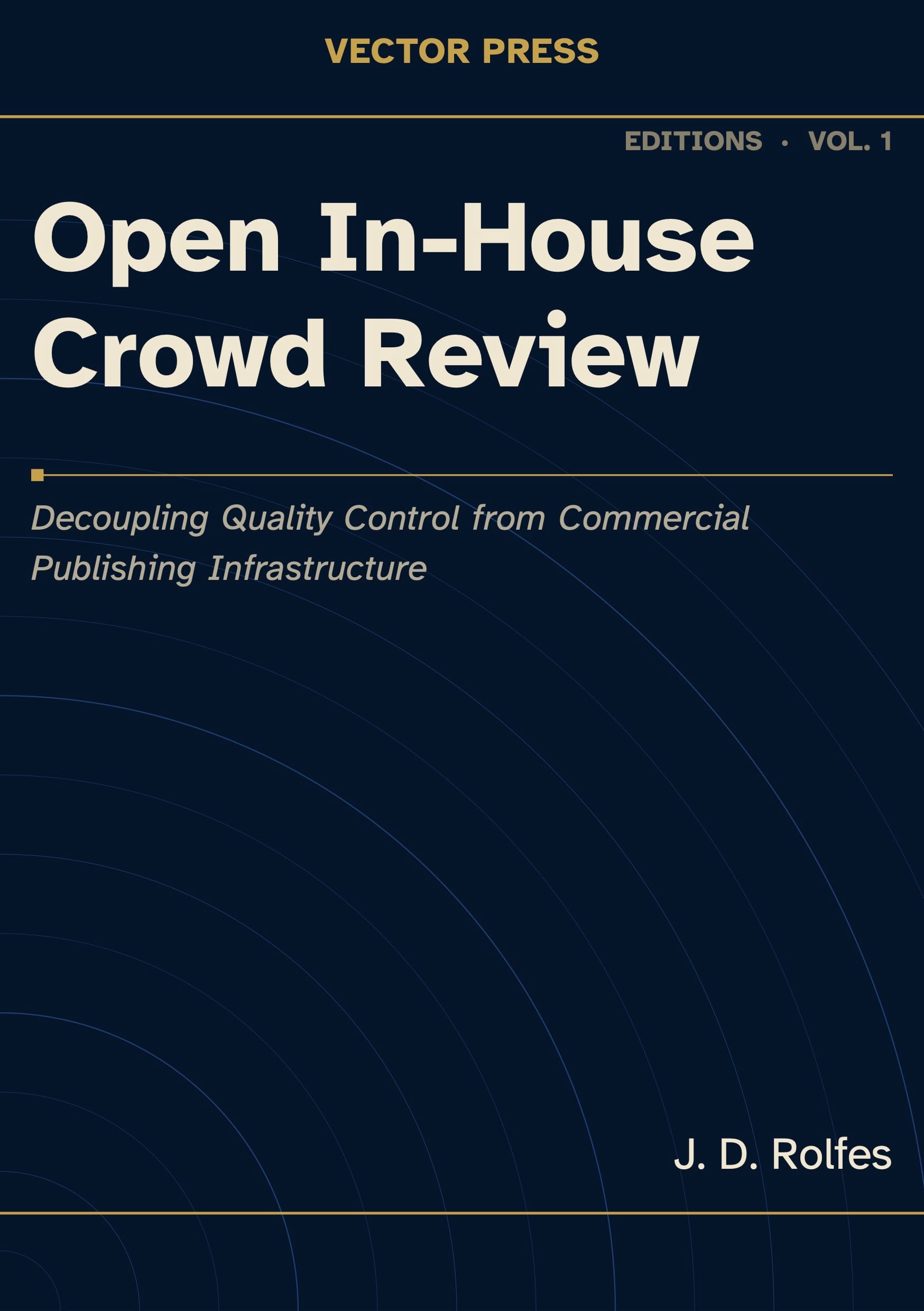
Open In‑House Crowd Review: Decoupling Quality Control from Commercial Publishing Infrastructure
Bibliographic Data:
Author: J. D. Rolfes
Series: Editions
Volume: 1
Publisher: Vector Press
First published: June 2026
License: CC BY‑SA 4.0
URL: vectorpress.pub/editions/1
Downloads:
About:
Scientific peer review was never built for epistemic justice. It was built to manage submission volume and protect commercial bottlenecks.
In our first Vector Press Edition, Open In‑House Crowd Review: Decoupling Quality Control from Commercial Publishing Infrastructure, J. D. Rolfes traces how today’s peer‑review system grew out of censorship, licensing, and impact‑factor management – and what it would take to build something structurally different.
The essay argues that the problem is not only procedure but infrastructure. A small number of commercial publishers now control most of the channels through which scientific work becomes visible. Article and book processing charges transfer financial risk away from publishers and onto researchers and institutions, while the labour of review remains unpaid. The result is a system that is slow, opaque, and structurally biased toward paradigm‑conforming, high‑visibility work.
Against this landscape, the text proposes Open In‑House Crowd Review (OICR): a model that relocates review and publication to the institutions that produce the research, anchors quality assurance in the producing community rather than a commercial intermediary, and makes Diamond Open Access a structural consequence rather than an optional add‑on. OICR combines institutional anchoring with open crowd review to address both pre‑publication gatekeeping and publisher dependence at the same time.
Along the way, the book maps existing reform approaches (open, post‑publication, and crowd review), examines the preprint ecosystem and shadow libraries, and develops two concrete implementation scenarios – from single institutions to inter‑institutional consortia. It closes with an honest discussion of unresolved challenges: prestige, inequality risks, moderation, and long‑term financing.
This volume is published as a Vector Press Edition under a Creative Commons Attribution‑ShareAlike 4.0 International license. It is free to read, free to download, and free to share under the terms of the license.