“Who Owns Peer Review?” – Launching Our First Vector Press Edition
In public and science, “peer reviewed” sounds like a guarantee. It signals that anonymous experts have scrutinised a piece of research and found it sound. Less visible is the machinery underneath: who owns the platforms, who sets the rules, and whose incentives those rules serve.
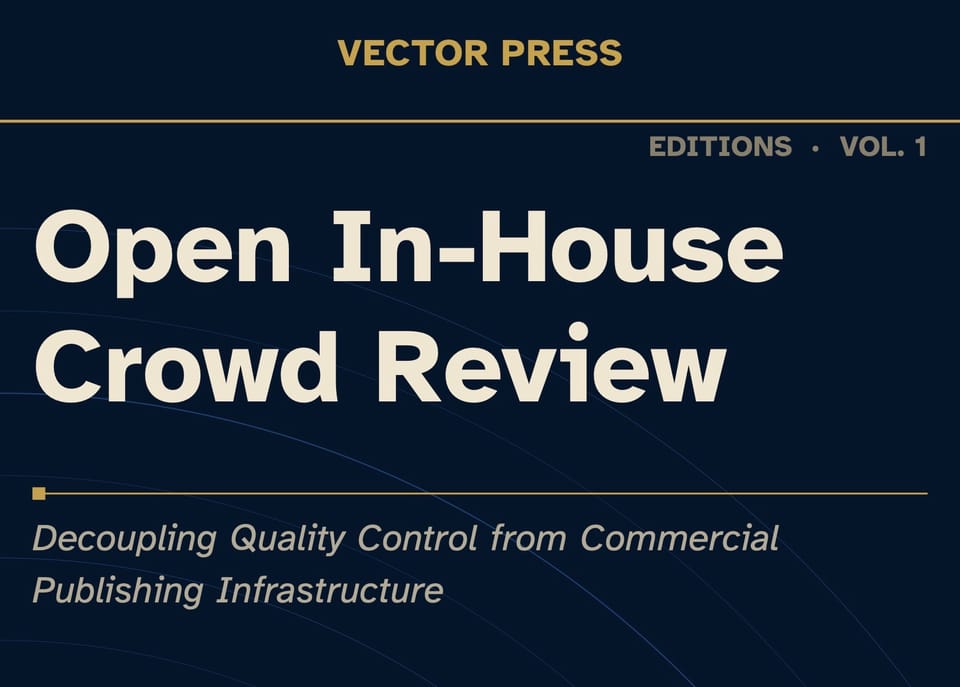
Our first Vector Press Edition, Open In‑House Crowd Review: Decoupling Quality Control from Commercial Publishing Infrastructure by J. D. Rolfes, begins exactly there. It argues that the core problem of peer review is not only how we review, but where and under whose control the reviewing takes place.
When Quality Control Runs On Commercial Rails
Over the last decades, most of the visible channels for scientific publishing have been consolidated into a small number of commercial houses. The labour of peer review is largely unpaid, provided by the same researchers whose institutions then buy back access to the resulting journals and books.
At the same time, the financial model has shifted. Article and book processing charges now routinely run into four‑figure sums, allowing publishers to recover their costs before a single copy is sold. The risk of publication is transferred away from the publisher and onto publicly funded institutions and grant budgets, while the decision‑making power over what gets through the gate remains with the publisher’s infrastructure.
The book traces this arrangement back to a longer history of censorship, licensing, and administrative gatekeeping. Peer review, as practiced today, is shown as a relatively recent addition to an older governance model that was never primarily designed for epistemic rigour.
OICR: Relocating The Gate
Instead of asking how to make the current system slightly more transparent, Open In‑House Crowd Review asks a different question: what would publishing look like if institutions and research communities took back responsibility for assessing the work they produce?
The answer it develops is Open In‑House Crowd Review (OICR). In the OICR model, manuscripts are reviewed and published on infrastructure controlled by the institutions that host the research, rather than being exported into a commercial black box. Review is open and conducted in public threads; comments are signed and visible, and the combination of institutional anchoring and crowd review is designed to make both constructive critique and political pressure structurally visible.
Importantly, Diamond Open Access is not an optional “goodie” glued onto the end of this process. By shifting costs from article‑level fees to shared institutional infrastructure—servers, editorial coordination, moderation—OICR makes “free to read, free to publish” a structural consequence.
Mapping The Landscape Of Reform – And Its Limits
The book does not present OICR in a vacuum. It systematically maps existing approaches to peer‑review reform, from classical blind review to open peer review, post‑publication commentary, and selective crowd review. Each model is analyzed not only for its procedural strengths and weaknesses, but also for the infrastructure it presupposes.
Alongside this, the book looks at parallel ecosystems that have emerged when the formal system fails researchers: preprints as the de facto primary literature in fast‑moving fields, Sci‑Hub and other shadow libraries, and alternative epistemic communities that have developed their own quality‑assurance norms.
Non‑commercial society and consortium journals are acknowledged as important precedents: they show that institutional anchoring is possible, but they typically retain the pre‑publication gate and do not structurally break dependency on the legacy publisher market. OICR’s specific contribution is to combine institutional control with open crowd review, addressing both gatekeeping and publisher dependency at the same time.
Feasibility, Not Fantasy
If this were merely a utopian sketch, it would be easy to dismiss. Instead, the book works through the hard questions: incentives for reviewers, protection against local bias, prestige dynamics, and financing.
- How do you prevent institutional review from collapsing into “review by friends and rivals”?
- How do you protect early‑career researchers who still have to navigate hiring committees that read journal titles as quality signals?
- How do you pay for infrastructure without recreating APC‑style inequalities between rich and poor institutions?
Two concrete implementation scenarios—one for a single institution, one for an inter‑institutional consortium—are developed to show what a transition could look like in practice, from staffing to funding flows. The book is explicit about what it cannot yet solve: the prestige lag, new inequality risks, moderation burdens, and the difficulty of running legacy journals and OICR side‑by‑side during a long transition period.
Why Vector Press Editions Starts Here
Vector Press is built around a simple commitment: access by design. Our mission is to make “free to read, free to publish” a structural property of the system, not a rare exception when a grant happens to cover an APC. Publishing Open In‑House Crowd Review as Volume 1 of our Editions series is therefore not a neutral choice. It is a statement about which questions we think need to be on the table if we want more just infrastructures of knowledge.
The book is written for a mixed audience: researchers, librarians, funders, science‑policy people, and everyone who has ever felt that something is structurally off in how we decide what counts as “real” knowledge. It offers a vocabulary for naming those problems and a concrete, if demanding, framework for experimenting with alternatives.
Open In‑House Crowd Review: Decoupling Quality Control from Commercial Publishing Infrastructure is available as a free PDF and EPUB from Vector Press Editions, under a Creative Commons Attribution‑ShareAlike 4.0 license.