"Solar Is Not Magic – But It Is Close": Patrick Owora On Everything You Need To Know About Going Solar In Uganda
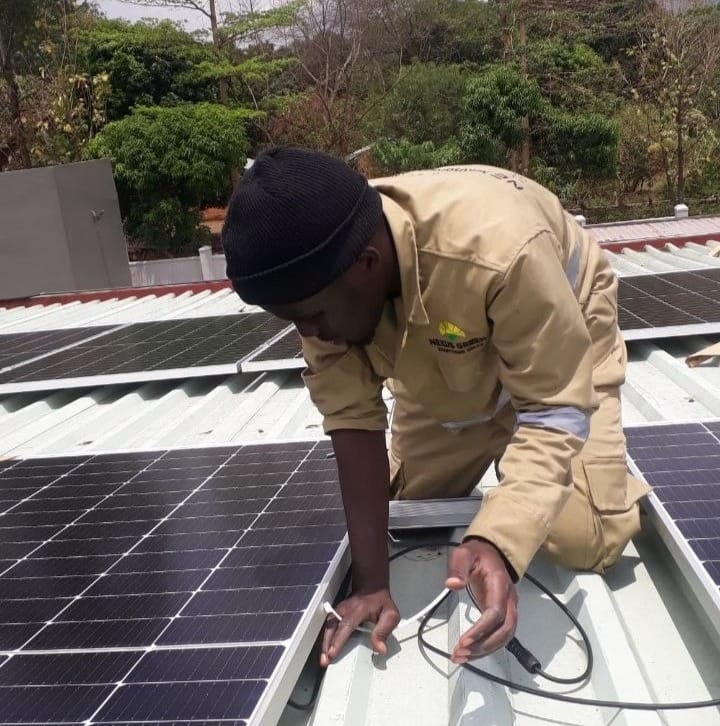
Most people who want solar panels do not want a physics lecture. They want to know if it will work on their roof, whether it will keep their lights on during a blackout, how long before it pays for itself, and whether they have to clean it.
Patrick Owora understands this. A solar energy expert with deep technical knowledge and an equally strong grasp of how ordinary Ugandan households and businesses actually interact with energy, Owora has spent considerable time translating the complex world of photovoltaics into decisions that make practical and financial sense.
In a detailed conversation covering everything from how a solar cell converts sunlight into electricity to what happens to a panel at the end of its life, Owora cuts through the myths, the marketing noise, and the technical jargon – leaving behind something more valuable: clarity.
"Solar is not magic," he says. "But when it is done right, it comes close."
"Uganda's solar resource is consistently strong – roughly 4.5 to 5.5 peak-sun-hours per day depending on location. Well-sited systems perform reliably year-round. The sun is not the problem. The design is."
How A Solar Panel Actually Works
Start with the basics, and Owora's explanation is refreshingly straightforward.
A photovoltaic cell – the fundamental unit inside every solar panel – converts sunlight into electricity. When photons from the sun strike the cell, they knock electrons loose, generating a flow of direct current (DC) electricity. An inverter then converts that DC electricity into alternating current (AC) – the form of electricity your home appliances, lights, and the national grid all use.
That is the core of it. But the real-world performance of any solar system is shaped by a more complex set of daily variables.
"Daily output varies with solar irradiance – how strong the sunlight is – along with shading, the orientation and tilt of your panels, soiling from dust and pollution, and how your inverter and grid connection are operating," Owora explains. "In hot climates like ours, environmental stressors also influence performance over time and contribute to long-term degradation."
The practical implication: two identical solar systems installed in the same city can perform very differently depending on whether one roof is shaded by a neighboring building in the afternoon, whether the panels are cleaned regularly, and whether the system has been correctly tilted toward the equator for maximum exposure.
Getting those details right at the design stage, Owora says, is what separates a system that performs as promised from one that disappoints.
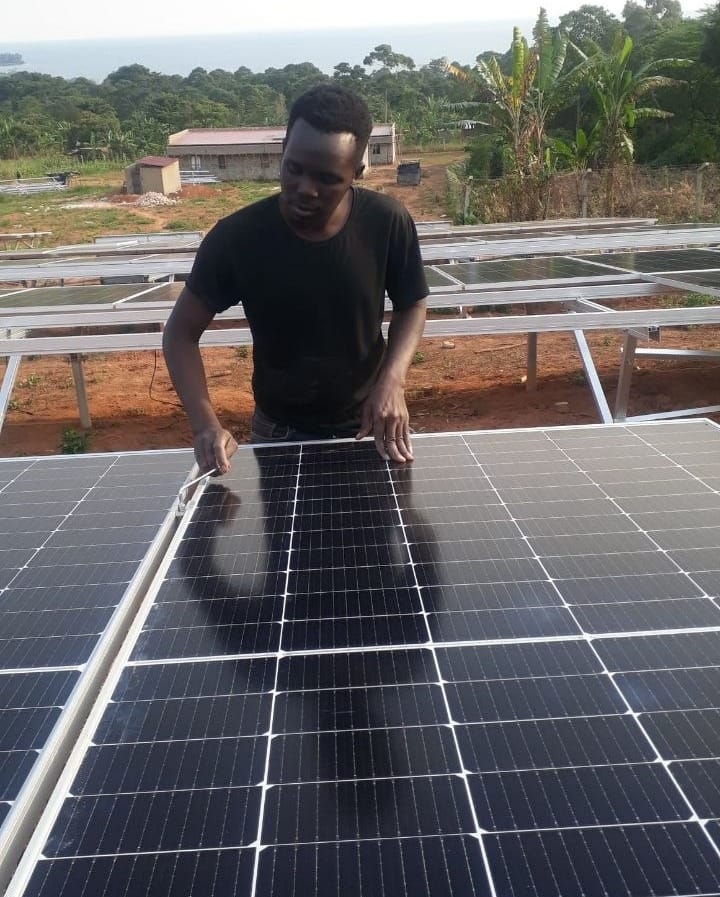
Rooftop or Ground-Mount – And Which Inverter?
The first practical question most people face when considering solar is where to put it. Owora's answer depends on a careful assessment of what you are working with.
Rooftop solar is appropriate when your roof is structurally sound, unshaded through the key solar hours of the day, and has adequate area for the system you need. The advantage is that it keeps balance-of-system costs down – you are using existing structure rather than building new support infrastructure. For a simple, unshaded rooftop, a string inverter is usually the most cost-effective choice.
But rooftops are not always straightforward. Complex shapes, multiple orientations, chimneys, water tanks, and neighboring buildings can all create partial shading problems that drag down the performance of the whole system if a standard string inverter is used.
"For complex roofs or roofs with partial shading, microinverters or DC optimizers are better," Owora says. "They limit shade losses to individual modules rather than pulling down the entire string."
Ground-mount solar comes into its own when you have available land, when the roof is shaded, structurally weak, or poorly oriented, or when you want the flexibility to set the optimal tilt angle and have easy access for maintenance and future expansion.
The inverter question becomes more critical, however, when you factor in Uganda's grid reliability challenges.
"Standard grid-tied systems shut off during blackouts for safety reasons," Owora explains. "It is called anti-islanding protection – the inverter stops generating to protect utility workers on the lines. If you want backup power during outages, you need a hybrid or backup-capable inverter that can form a local microgrid, along with a battery and a dedicated essential loads sub-panel."
This is one of the most important distinctions for Ugandan households, where power outages remain frequent. Only 28% of Ugandans have grid connections, according to Afrobarometer 2024 data, and even among those who do, reliability is a persistent challenge. A solar system without battery backup and a hybrid inverter provides no power at all the moment the grid goes down.
Some microinverter ecosystems can provide limited daytime backup when paired with the correct controller – but Owora is clear: a battery greatly improves reliability at night and during cloudy periods, and is strongly recommended for anyone who needs genuine energy security rather than just bill reduction.
"If you want backup power during outages, you need a hybrid inverter, a battery, and a dedicated essential loads sub-panel. A standard grid-tied system gives you nothing the moment the grid goes down."
The Policy Landscape – Net Metering, Feed-In Tariffs, and Retail Rates
For anyone calculating whether solar makes financial sense, understanding Uganda's current policy and tariff environment is essential. Owora walks through the landscape with precision.
Net metering – the framework that allows solar system owners to export surplus electricity to the grid and receive credits against their bills – came into full nationwide force in Uganda in 2024. Residential, commercial, and industrial customers who install solar and connect to the grid can now export surplus generation and receive energy credits. Those credits, when they draw power back from the grid, are applied with a 20% discount on imported energy – representing the grid operator's cost for maintaining the network.
Systems up to 500 kW are eligible. Bi-directional smart metering and proper interconnection are required – meaning installation must meet technical standards, not simply any panel screwed to a roof.
"Net metering changes the financial calculation significantly," Owora says. "Daytime exports offset later imports, which usually shortens payback compared to the old rules."
For larger utility-scale and developer projects selling power directly to the grid, Uganda's Renewable Energy Feed-In Tariff (REFIT Phase VI) sets the solar PV purchase price at 5.1 US cents per kilowatt-hour for projects up to 50 MW. This is not a household program – but it provides important context for the economics of the broader sector.
The retail tariff structure matters enormously for household payback calculations. The Electricity Regulatory Authority (ERA) publishes quarterly tariffs; for Q1 2025, domestic customers pay from USD 0.068/kWh for the first 15 kilowatt-hours to approximately USD 0.21/kWh in higher consumption blocks. The higher your consumption – and therefore the higher tariff block you are paying at the margin – the faster a solar investment pays back.
"Model with your own loads and your own tariff block," Owora advises. "Generic payback figures can be misleading because the math is very specific to each household."
Costs, Payback, And What To Expect Over A Lifetime
Owora resists the temptation to offer headline payback figures that may not apply to any specific household – and for good reason. The financial performance of a solar system is highly specific to system cost, self-consumption patterns, net metering credits, and which tariff block a household is avoiding.
What he can offer are the lifetime expectations of system components – information that is critical for any honest cost-benefit analysis.
Solar modules are the most durable component of any system. Modern panels carry warranties of 25 years or more, with typical degradation of less than 1% per year in normal operating conditions. In hot climates, degradation rates can vary with temperature and environmental stress, but a well-chosen module should deliver meaningful generation for 25 to 35 years.
Inverters have shorter lifespans. String inverters typically require replacement after 10 to 15 years. Some microinverter and module-level power electronics (MLPE) products offer longer warranties – an important consideration when comparing upfront costs between inverter types.
Batteries introduce the widest range of lifetime variability. Depending on chemistry – lead-acid versus lithium-ion – and how deeply and frequently the battery is cycled, lifetimes range from 5 to 15 years. Checking warranty terms and understanding the cycling conditions under which the warranty applies is essential before purchase.
On maintenance, Owora's advice is practical and site-specific rather than prescriptive.
"Monitor performance regularly, do visual and electrical checks, and clean panels when soiling is significant," he says. "But optimize your cleaning intervals for local dust and rainfall patterns. Cleaning too frequently wastes water and maintenance budget. Cleaning too rarely costs you generation. Find your site's optimal rhythm."
Keeping The Lights On – Designing For Resilience
For households and businesses that have experienced Uganda's grid reliability challenges – which is to say, most of them – the question of what happens when the grid goes down is not hypothetical. It is the deciding factor in whether a solar investment delivers real value or merely reduces a bill.
Owora lays out the components of a genuinely resilient solar system with clarity.
The foundation is a hybrid or backup-capable inverter – specifically one that can operate in "grid-forming" mode, meaning it can create and maintain a local electrical supply independent of the utility grid. This is fundamentally different from a standard grid-tied inverter, which shuts down the moment it detects a grid failure.
Paired with the hybrid inverter is a battery bank sized to cover your critical loads – the refrigerator, lights, phone charging, medical equipment, or whatever you cannot afford to lose power to. The battery feeds these loads through a dedicated essential loads sub-panel that is wired separately from the rest of the building.
An automatic transfer or isolator switch manages the handover between grid and battery-backed operation seamlessly – so that when the grid fails, critical loads switch over without manual intervention.
"This is the architecture that gives you genuine energy security," Owora says. "Without it, you have a bill-reduction tool. With it, you have resilience."
"Without a hybrid inverter, battery, and proper transfer switching, you have a bill-reduction tool. With them, you have genuine energy security. That distinction matters enormously for households dealing with frequent outages."
Solar For Renters And Low-Income Households
One of the most important questions in Uganda's energy access conversation is whether solar can genuinely reach the households that need it most – renters who cannot modify a roof they do not own, and low-income families for whom any upfront cost is a barrier.
Owora points to Uganda's thriving Pay-As-You-Go (PAYGo) solar market as the most practical pathway available today.
PAYGo solar home systems and appliance bundles – lanterns, multi-light kits, small televisions, fans – allow households to pay in installments via mobile money, with the system locked remotely if payments lapse and unlocked when they resume. No land title required. No bank relationship required. No roof modification required.
Uganda's off-grid PAYGo sector has grown strongly, supported by results-based financing programs including the Beyond the Grid Fund for Africa and the Energy and Electrification Support Project. PAYGo receivables in Uganda's off-grid market reached approximately USD 87 million in 2022, demonstrating real scale of adoption among lower-income consumers. Companies like ENGIE/Fenix have connected hundreds of thousands of households to solar home systems across the country through this model.
"For renters and lower-income households, PAYGo is the most accessible pathway," Owora says. "You are not locked out of the transition just because you do not own your roof or cannot pay upfront. The market has moved significantly toward meeting people where they are."
Community solar models – where multiple households or businesses share a solar asset and its generation – offer another pathway, particularly in the context of mini-grid development in rural areas where individual ownership is not feasible.
The Myths That Cost People Money And Confidence
Owora has heard them all. The myths about solar that circulate in markets, WhatsApp groups, and neighborhood conversations – some that lead people to reject solar unnecessarily, and others that lead them to buy systems that fail to deliver what they expected.
He addresses the three most damaging with particular directness.
Myth 1: "Solar doesn't work here – it's too cloudy."
Uganda receives approximately 4.5 to 5.5 peak-sun-hours per day depending on location, according to Global Solar Atlas data – a strong and consistent solar resource that makes well-sited systems reliable year-round. Even during Uganda's rainy seasons, diffuse light continues to generate meaningful output. The sun is not the constraint. Poor system design is.
Myth 2: "Any solar panel will keep my lights on during a blackout."
This is perhaps the most consequential misconception – and the one most likely to result in a disappointed customer.
"Only systems specifically designed for islanding and backup – with a hybrid inverter, a battery, and proper transfer switching – power loads during outages," Owora says firmly. "A standard grid-tied system gives you nothing when the grid goes down. Nothing. This needs to be understood before purchase, not after."
Myth 3: "Solar panels never need cleaning."
Soiling – dust, pollution, bird droppings – causes measurable energy loss in most environments. Uganda's dry season, construction activity, and road dust all contribute to panel soiling that accumulates over weeks and months. Panels do need cleaning. The question is how often, and the answer is site-specific.
"Clean when soiling is significant," Owora advises. "But do not over-clean either – you waste water and maintenance budget. Monitor your system's output regularly and let the numbers tell you when cleaning is due."
"A standard grid-tied solar system gives you nothing when the grid goes down. Nothing. This is the most consequential misconception in the market – and it needs to be understood before purchase, not after."
What Happens When A Solar Panel Dies?
The energy transition's credibility depends partly on whether it can account for its own waste – and Owora does not shy away from the question of what happens to solar modules and batteries at the end of their working lives.
For solar PV modules, the picture is one of a recycling industry that exists and is growing, but has not yet reached the scale or economics that make recycling straightforwardly viable everywhere.
"Modules contain glass, aluminum, silver, and silicon – all recoverable," Owora explains. "Recycling pathways exist. But in many markets, the cost of recycling still exceeds the cost of landfill disposal, so policy and technology are both evolving to recover more value at scale."
Reuse of modules – particularly those removed from systems due to upgrades rather than failure – is a growing practice that extends useful life before recycling becomes necessary. The modules removed from a domestic rooftop after 20 years may still generate meaningful power for a lower-intensity application.
For batteries, the situation varies by chemistry. Lead-acid battery recycling is a mature, well-established industry – lead is a high-value recovered material with strong recycling economics. Lithium-ion battery recycling is a younger and rapidly expanding sector, driven by the same critical minerals – lithium, cobalt, manganese, nickel – that make the batteries valuable in the first place.
Owora's practical recommendation for consumers is straightforward: choose vendors who have take-back programs or referenced recycling partners. If a supplier cannot tell you what happens to the battery at end of life, that is a gap in their accountability.
"The transition cannot be clean at the front end and dirty at the back end," he says. "We need to close the loop – and we need consumers to ask the right questions to create the pressure for vendors to do so."
The Bottom Line – Doing Solar Right
What emerges from Patrick Owora's detailed account of Uganda's solar landscape is not a simple endorsement of solar as a cure for all energy challenges – but something more nuanced and more useful: a framework for doing it right.
The technology works. Uganda's solar resource is strong, consistent, and more than adequate for reliable year-round generation. The policy environment – with net metering in force, REFIT providing developer certainty, and PAYGo models expanding access – has never been more favorable.
But the design choices matter enormously. The difference between a system that delivers on its promise and one that disappoints often comes down to inverter selection, battery sizing, shading assessment, and whether the installation was done by someone who understood what the customer actually needed – not just what was cheapest to sell.
"Solar is not magic," Owora repeats. "But when it is designed properly, installed correctly, maintained appropriately, and matched to the right financial model for the household – it comes very close."
For Uganda, where energy access remains one of the most significant barriers to household welfare, economic opportunity, and climate resilience, getting that right is not just a technical matter. It is a development imperative.
"Solar is not magic. But when it is designed properly, installed correctly, maintained appropriately, and matched to the right financial model – it comes very close. Uganda has the sun, the policy, and the market. What we need now is the knowledge and the quality to match."
– Patrick Owora, Solar Energy Expert, Uganda
Patrick Owora is a Ugandan solar energy expert specializing in photovoltaic system design, grid integration, energy policy, and making solar technology accessible and financially viable for households and communities across Uganda.